What is Conflict First Aid™?
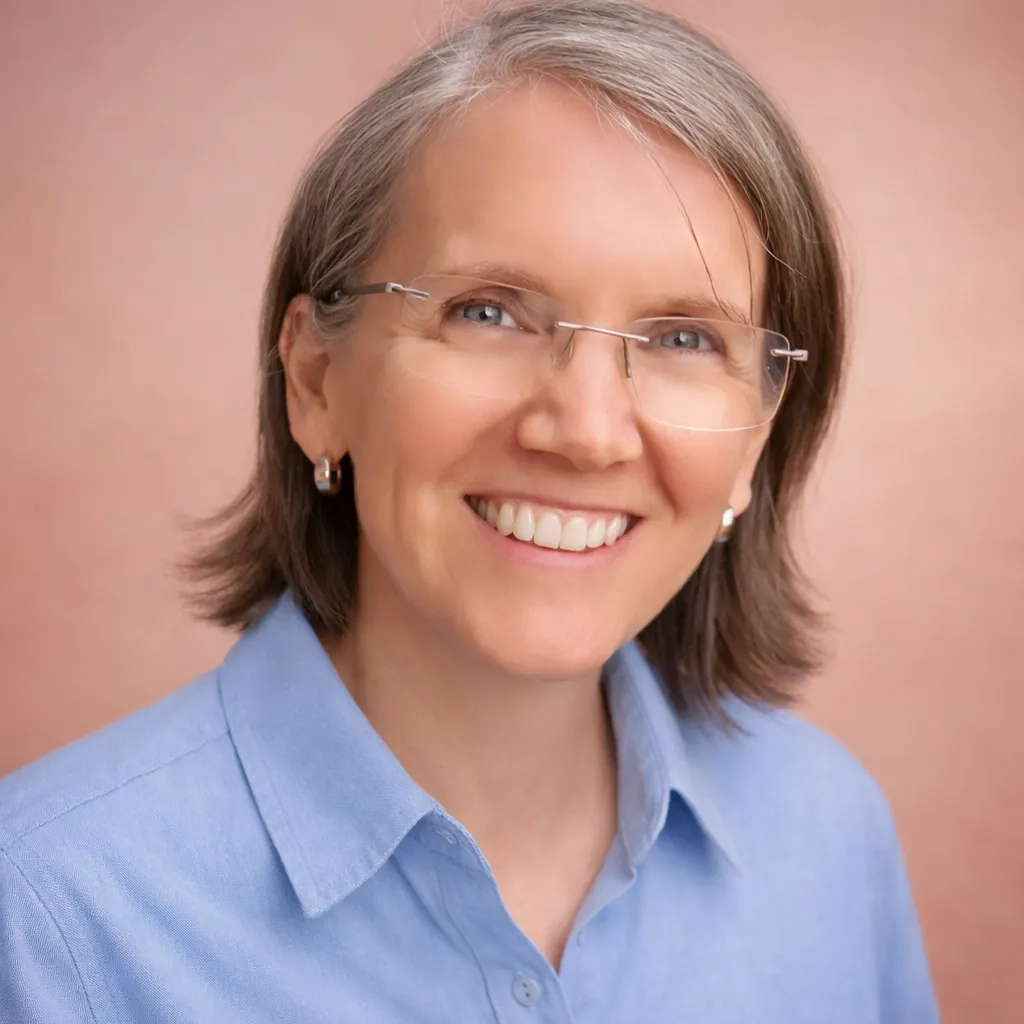
Click the explainer video, meet the founder:
Conflict First Aid™ competencies fill a critical gap in the conflict toolbox and management spectrum.
It takes minutes, keeps you out of the middle, and helps address a blip or waypoint—a past, present or anticipated concern, complaint, challenge or conflict.
Joan Feringa, Founder
News at 11.
We’re working on it. Scroll down to learn why you’ll want to join the waitlist now.
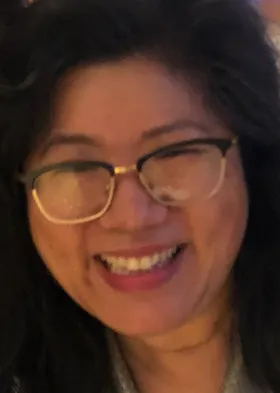
"when stakes are high and failure isn’t an option”
Andrea J. Lee (Author, We Need to Talk, Your Guide to Challenging Business Conversations)
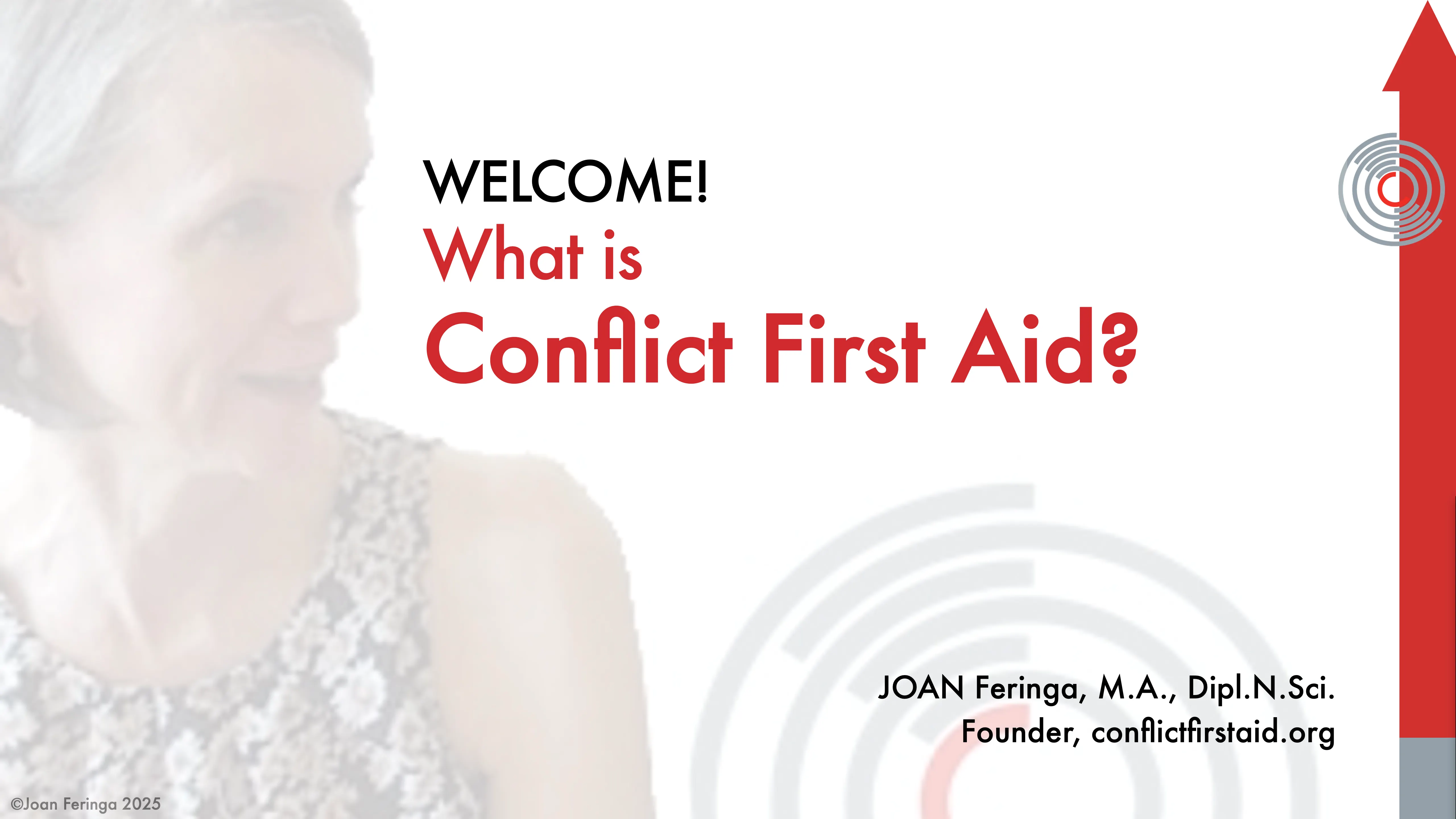
Joan worked in and managed both non-traditional and conventional environments with work spanning conflict management, mediation/facilitation, leadership and organizational systems. She became a scholar-practitioner in conflict management, and led, coached and managed teams across industry, government and academia and currently teaches and coaches collaborative practice at the School of Health, Community, and Social Justice at the Justice Institute of British Columbia and serves as a director on the boards of Mediate BC and the HMCS QUADRA Alumni Association .
Her 2002 Master's thesis, 'Conflict Management Systems: A Hammer, or the Complete Toolbox?', examined whether the conflict-handling spectrum provided people and organizations with the range of tools they actually needed.
The answer was that a great deal was already available.
In 2017, Joan experienced a pivotal moment in a Mental Health First Aid workshop. Some of the learners, mental-health nurses, despite their specialist expertise supporting people in escalated mental-health crises, expressed that they had few, if any, of those first-aid competencies.
The experience brought an important distinction into focus for Joan: specialist expertise does not automatically include first-aid knowledge or competency. It was certainly true for conflict specialists and scholars who, in her experience, were often deeply mired in conflicts themselves.
Joan says, "I finally recognized that day that the same function was clearly missing, even for conflict-management specialists. I could not find that function in any system I knew, researched or had worked in, including at their most accessible, everyday and crucial touchpoints. Further, Conflict First Aid™ hadn't surfaced as 'lowest level' and it was not another form or application of early, alternative, or collaborative practice, coaching, mediation or professional conflict intervention. It surprised me that neither was it something limited to early conflict. It could be applied across the spectrum as first aid."
Joan's sense of it in those first moments of discovery wasn't wrong. The same night after the Mental Health First Aid 'aha' moment, she checked: the domain name "conflictfirstaid" (in every version, .com, .net, .org) was available. It had been hiding in plain sight.
Her google search highlighted some use of it in professional, not voluntary, circles as a form of conflict intervention, coaching or pre-mediation 'stage'. A book had been written pointing to that application but not at all to what the gap called out for.
It was startling to recognize the void along the conflict handling theory, intervention, handling and management spectrum - and still is. Though scattered across self-regulation, justice, peace and other studies, the competencies for Conflict First Aid™ were still only considered specialist expertise. First-aid competency occupied different places entirely.
What research, experience, and years surrounded by conflict expertise could not find was a clearly named, widely accessible first-aid function for conflict: brief, bounded help that any of us could learn and use when a concern, complaint, challenge or conflict surfaces, without becoming the specialist or taking over the conflict.
We need that function because conflict carries personal, relational, community, workplace, systemic and global costs. It parallels what we already know and rely on as standard first aid: ordinary, widely accessible physical-health support within a broad ecosystem that remains distinct from specialist medical and nursing practice.
The name followed logically: Conflict First Aid™ .
Conflict First Aid™ competencies help whoever is in, near, or affected by conflict and its complications and consequences.
Making Conflict First Aid™ ordinary and accessible will take many of us.
If you're curious about the work or want to help build it? Find a cohort to learn it and learn with them. Bring Joan (she still does it!) in for a briefing or introductory workshop.
Figure out how to integrate it into your systems for leadership, teams, health and wellbeing.
It helps with all of that.
Wish you could ask the founder a question?
She'll answer!
Email her, here: [email protected] or book time with her here.
A sequence of 5 SAFE steps that are straightforward, evidence-based competencies that can be your new, better, helpful conflict-defaults.
Conflict First Aid™ Foundations can be learned in just hours. You and your community or team will be ready to begin honing the competencies so you're practice-ready.
Practice Cohorts are underway - or can be invited - and they're currently free or very low cost.
NOTE: As promised, Conflict First Aid™ Plank Owners, Community Practice Portal and #ConflictSchool opportunities both online or in person are returning soon.
What does this mean? Frankly, we’re taking the time to hone the foundations. Joining now still means being part of things on the ground floor.
---
Those who have been part of it so far are SO appreciated!
(See “Plank Owners” in the top menu, but it’s NOT too late. We’re still in Foundations and Stewardship mode, and you can join us.)
Joining the list now means you'll access a world of exclusive benefits of being here early, engaging in the learning, research and early cohort experiences as the movement grows.
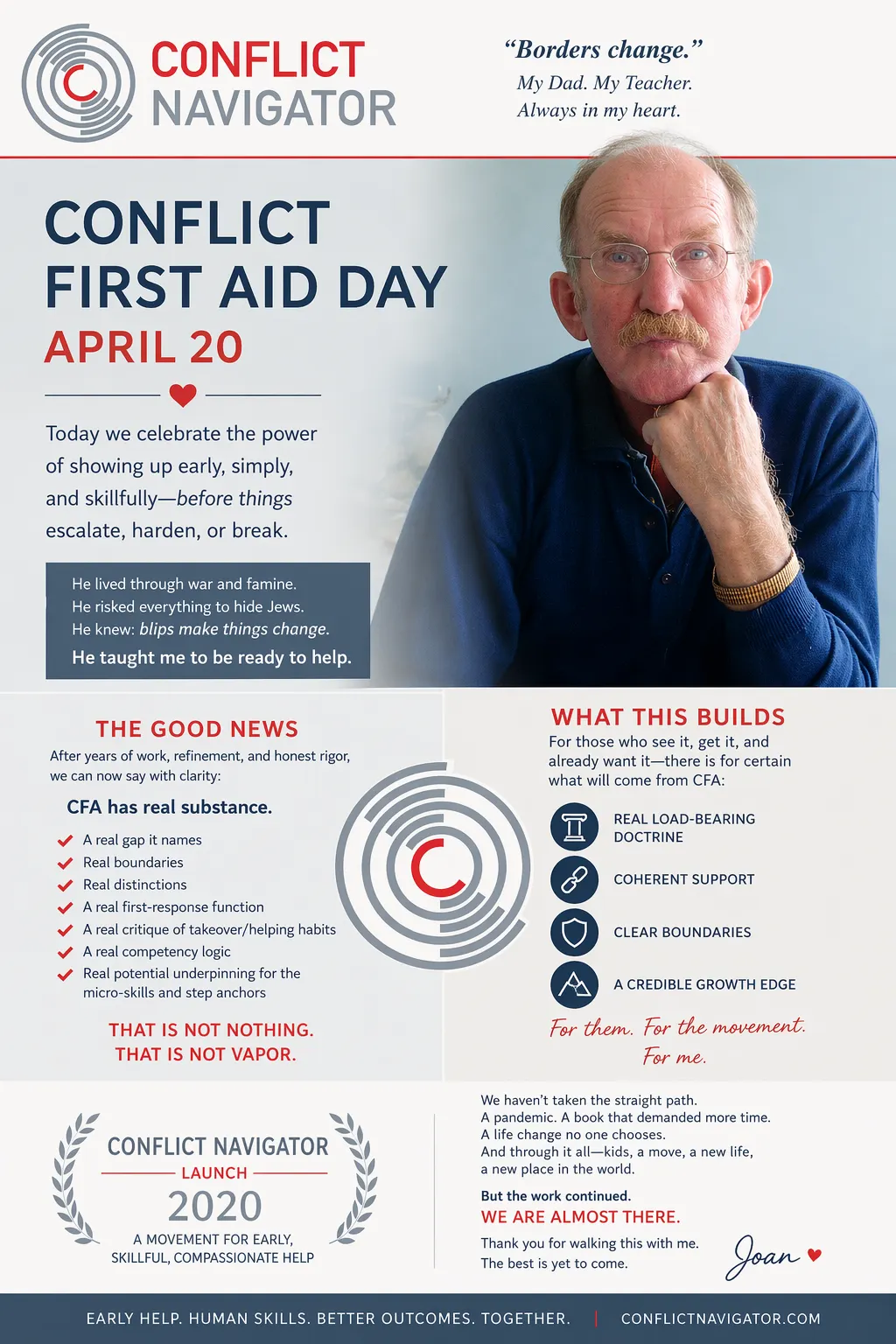
Conflict First Aid Day — was April 20th, 2026
Celebrate Conflict First Aid Day with us next year!
Conflict prevention and resolution options can help.
Reach out here. We are part of a community of practice - and are happy to connect you.

Spread the word yourself!